A Realism Buddha Tattoo combines the peaceful imagery of Buddha with the precision and depth of realism tattooing. Through detailed facial expressions, smooth shading, carefully controlled highlights, and subtle textures, tattoo artists can create Buddha portraits that appear almost three-dimensional on the skin. Beyond its visual appeal, a Buddha tattoo can carry deep personal and spiritual meaning. Depending on the design, it may represent inner peace, wisdom, compassion, mindfulness, balance, or the journey toward enlightenment. For those who appreciate detailed Realism Tattoo art, Buddha imagery offers a powerful combination of technical beauty and meaningful symbolism.
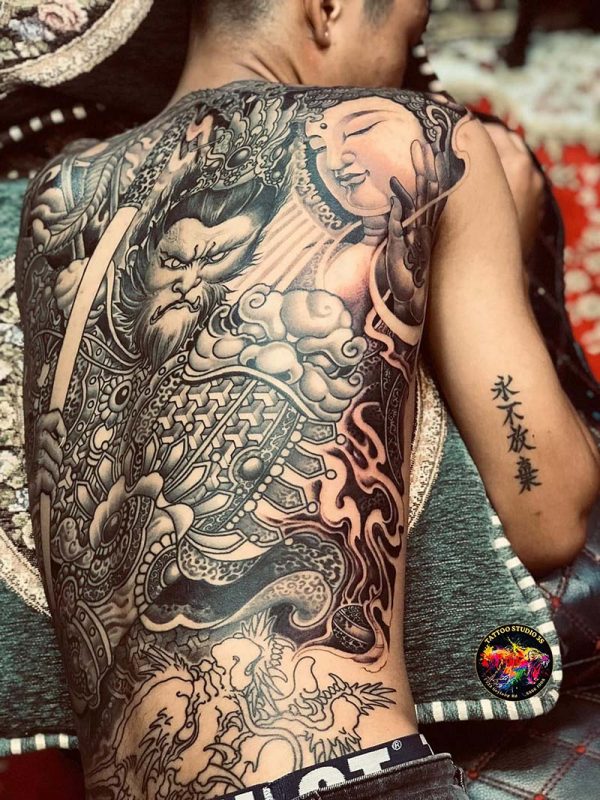
What Is A Realism Buddha Tattoo?
A Realism Buddha Tattoo is a tattoo style that portrays Buddha with lifelike proportions, detailed facial features, natural shading, and a strong sense of depth. Instead of relying primarily on bold outlines or simplified forms, realism techniques use smooth transitions between light and shadow to create a more dimensional appearance.
These designs may be inspired by traditional Buddhist artwork, Buddha statues, meditation imagery, temples, or contemporary interpretations. Some pieces focus exclusively on Buddha’s face, while larger compositions may incorporate lotus flowers, mandalas, Bodhi trees, clouds, temples, or sacred geometric patterns.
Similar to a Realism Statue Tattoo, the artist may recreate the texture and appearance of carved stone when working from Buddha statue references. Careful shading can make the design appear sculpted rather than simply drawn onto the skin.
Key characteristics of Realism Buddha Tattoo include:
- Realistic shading and smooth gradients: Soft transitions create depth and natural contours.
- Detailed facial expressions: Subtle details help capture a peaceful and meditative appearance.
- Light and shadow effects: Strategic contrast gives the image stronger dimension.
- Three-dimensional depth: Highlights and shadows make the Buddha appear more lifelike.
- Fine details and textures: Hair, robes, skin, stone, flowers, and surrounding elements can be rendered with precision.
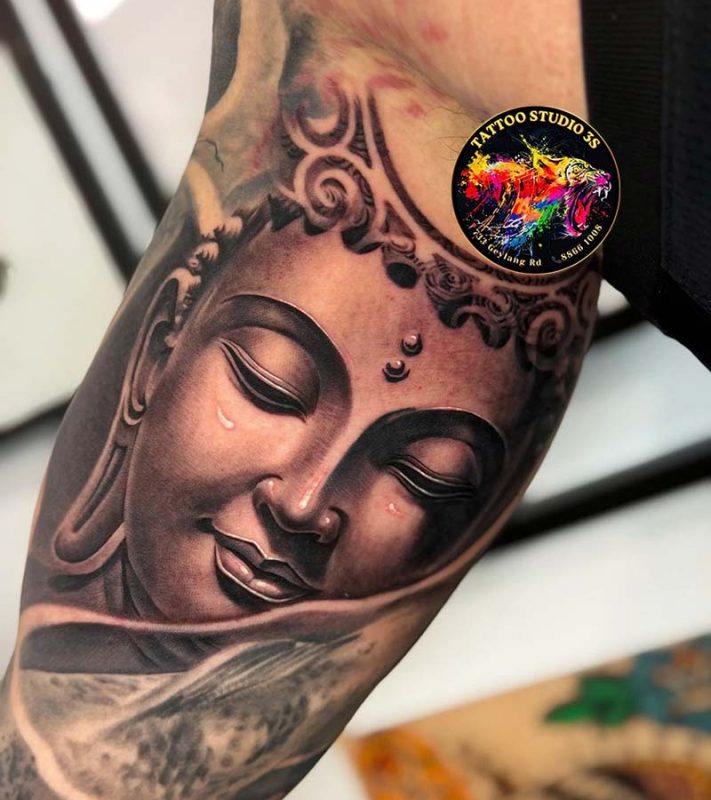
Realism Buddha Tattoo Meaning
The meaning of a Realism Buddha Tattoo can vary depending on the specific image, accompanying symbols, and personal intentions of the wearer. Buddha imagery is closely connected with Buddhist teachings, so understanding its cultural and spiritual context is important before choosing a design.
– Peace And Inner Calm: The calm expression commonly seen in Buddha imagery can represent peace, emotional stability, and a quiet mind. A Buddha tattoo may serve as a personal reminder to remain composed even during stressful or challenging moments.
– Wisdom And Enlightenment: Buddha is strongly associated with the pursuit of wisdom and enlightenment. For some wearers, the tattoo represents continuous learning, deeper understanding, and the desire to see life with greater clarity.
– Compassion And Kindness: Compassion is an important principle in Buddhist philosophy. A Buddha tattoo can therefore represent empathy, kindness, and the intention to treat other people with understanding and respect.
– Spiritual Growth: A Realism Buddha Tattoo may represent an individual’s spiritual journey rather than a final destination. It can symbolize personal transformation, self-discovery, and the continuous effort to develop a deeper understanding of oneself.
– Balance And Harmony: Buddha imagery is often associated with balance between the mind, body, and emotions. The tattoo can serve as a reminder to seek harmony instead of becoming overwhelmed by extremes.
– Mindfulness And Self-Awareness: Mindfulness encourages awareness of the present moment. A Buddha tattoo may symbolize the intention to become more conscious of one’s thoughts, emotions, actions, and surroundings.
Realism Buddha Tattoo Ideas Worth Considering
There are many ways to interpret Buddha imagery through realism. The right design depends on the meaning you want to express, the available tattoo area, and whether you prefer a traditional, artistic, or contemporary composition.
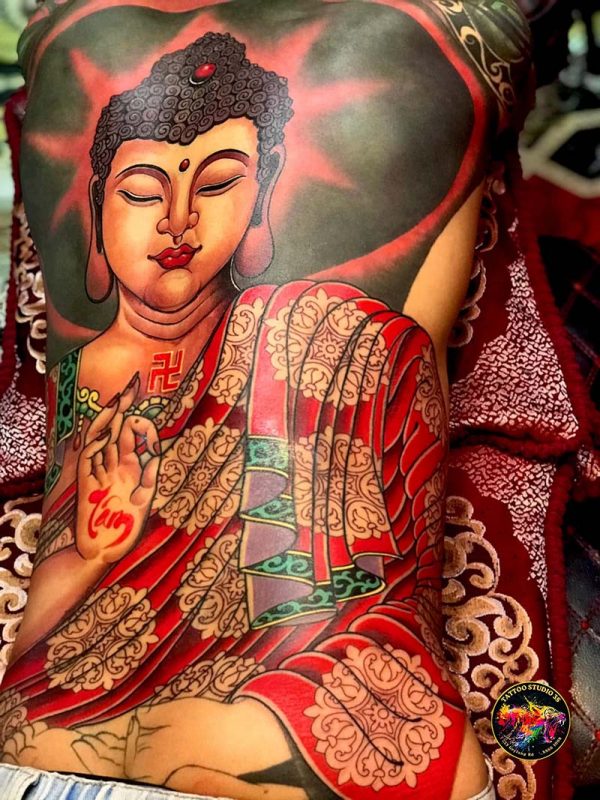
1. Meditating Buddha Tattoo
A Meditating Buddha Tattoo typically depicts Buddha seated in a peaceful meditation pose. The balanced posture and calm expression make this design closely associated with mindfulness, inner peace, patience, and spiritual awareness. Larger designs can include lotus flowers, temple architecture, mountains, clouds, or natural scenery to create a complete composition.
2. Buddha Face Tattoo
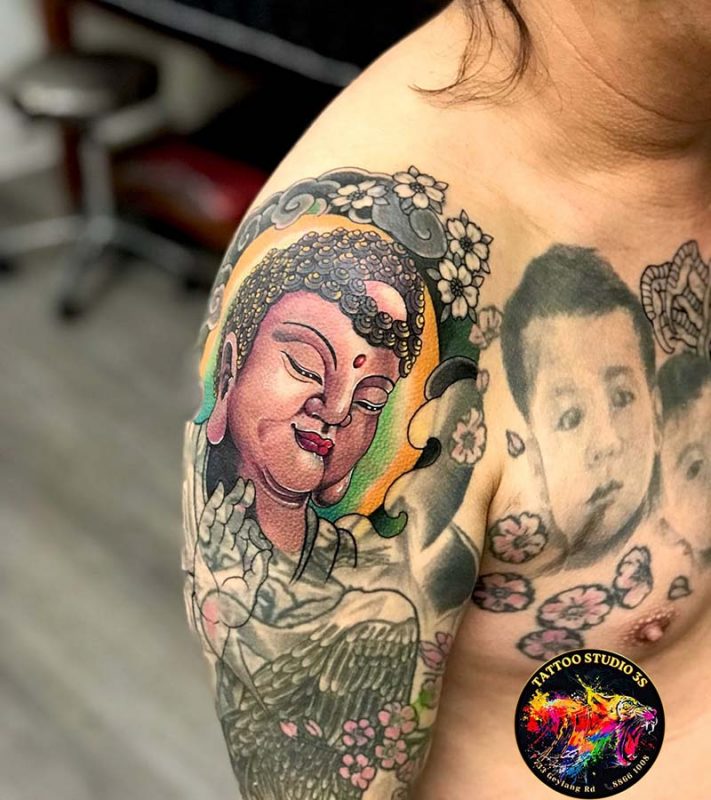
A Buddha Face Tattoo focuses primarily on facial expression. Closed or gently lowered eyes, subtle highlights, and smooth shadows can create a powerful feeling of calm and introspection. Because the face is the main focal point, accurate proportions and detailed shading are particularly important.
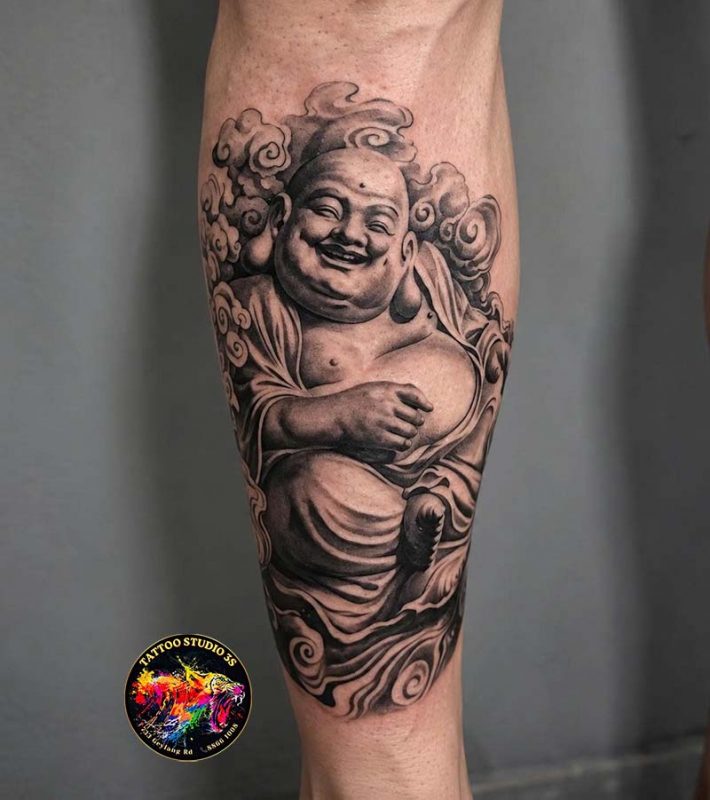
3. Laughing Buddha Tattoo
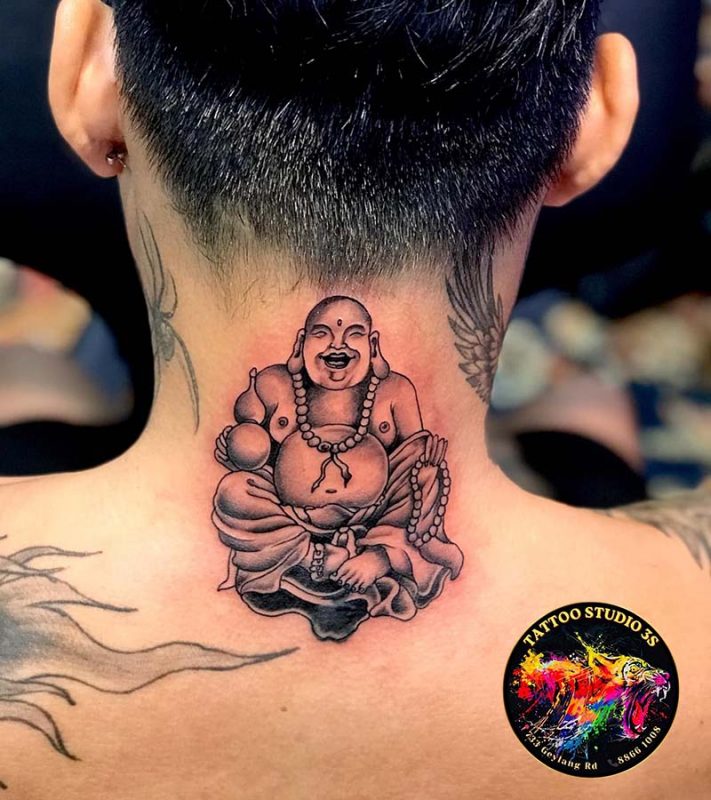
The Laughing Buddha is commonly associated in popular culture with happiness, abundance, prosperity, and good fortune. Its joyful expression creates a noticeably different atmosphere from the calm and contemplative imagery associated with Siddhartha Gautama. A realism approach can emphasize the expressive face, flowing robes, and rounded forms of the figure.
4. Buddha Head Tattoo
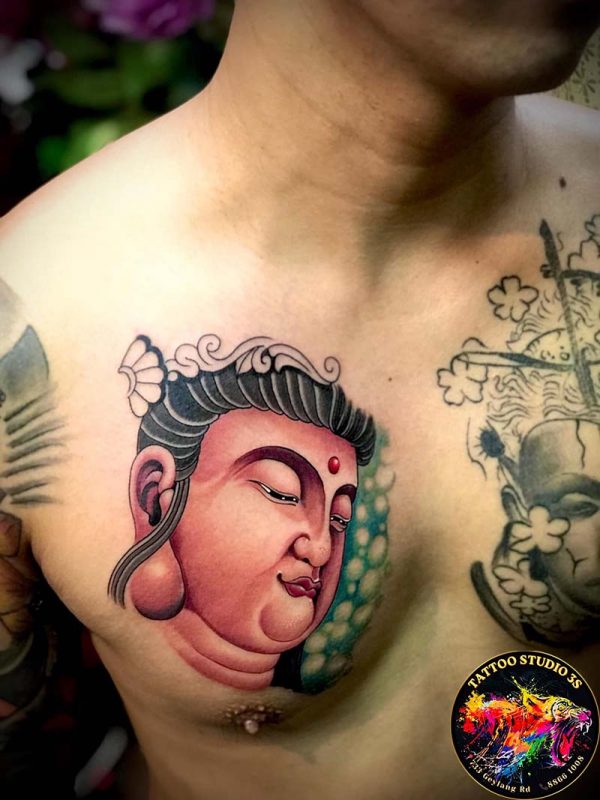
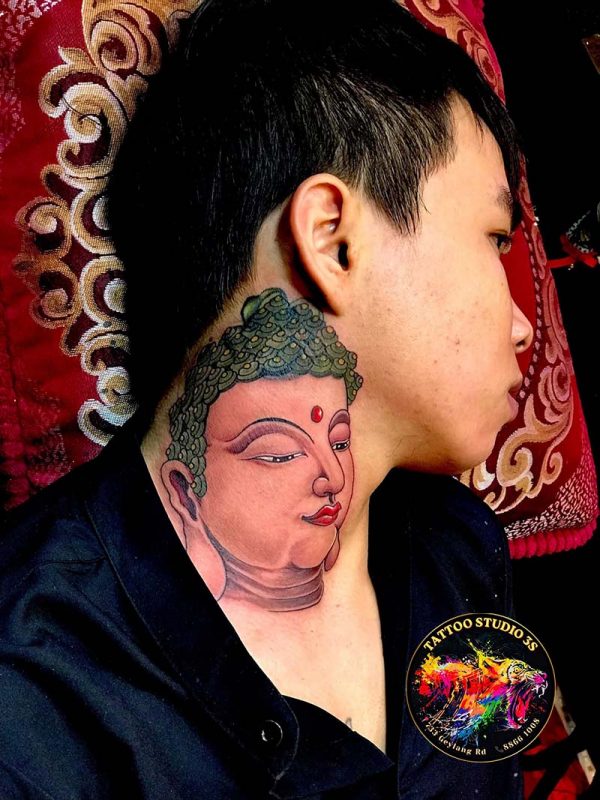
A Buddha Head Tattoo concentrates on the head and facial features, making it suitable for portrait-style compositions. Detailed curls, facial contours, closed eyes, and smooth shading can create a visually striking piece. Because detached Buddha-head imagery can be culturally sensitive in some Buddhist communities, it is worth understanding the context and discussing a respectful composition with your artist.
5. Buddha Statue Tattoo
A Buddha Statue Tattoo recreates the appearance of a carved Buddha sculpture on the skin. Artists can use black and grey shading, highlights, cracks, and subtle textures to imitate stone, bronze, or aged surfaces. This style is particularly suitable for people who appreciate classical sculpture and highly detailed realism.
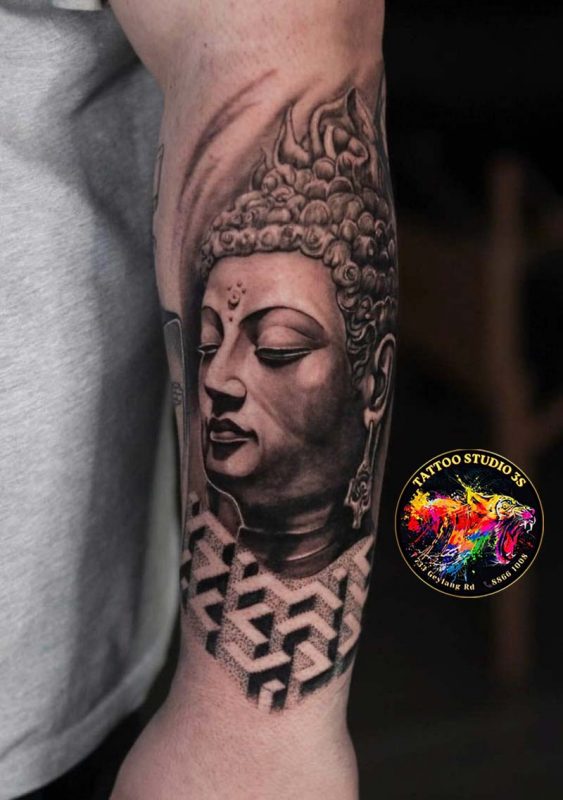
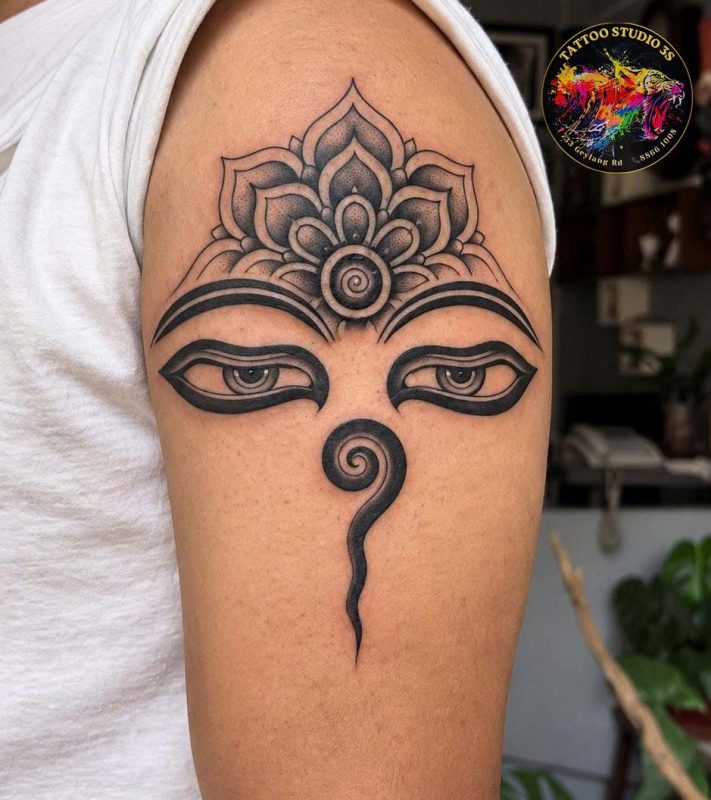
6. Buddha Eyes Tattoo
Buddha eyes are often associated with awareness, wisdom, and spiritual perception. They can become the central focus of a larger Buddha composition or be incorporated with mandalas and other symbolic elements.
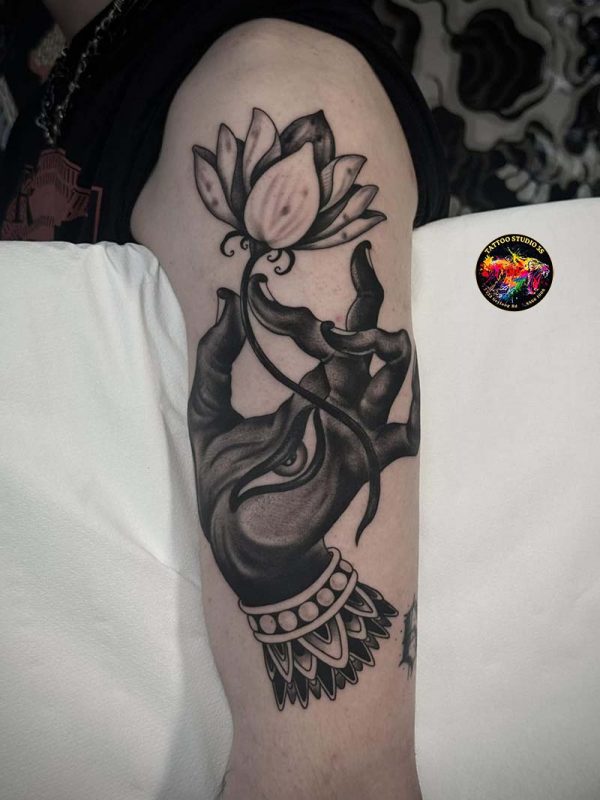
7. Buddha Hand Tattoo
Buddhist hand gestures, or mudras, can carry different symbolic meanings depending on their form and tradition. A realistic hand-focused design can emphasize intricate finger positions, shadows, jewelry, or surrounding spiritual elements. Understanding the specific mudra before incorporating it into a tattoo helps ensure that its symbolism matches your intended meaning.
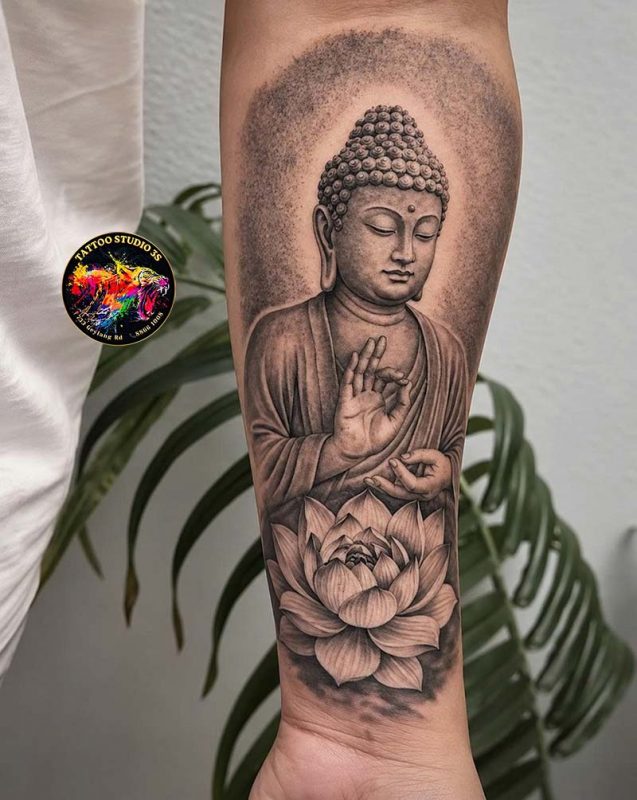
8. Buddha And Lotus Tattoo
The lotus is one of the most recognizable symbols associated with Buddhism. Growing from muddy water while producing a beautiful flower, it is commonly connected with purity, spiritual development, and enlightenment. Combining Buddha with a lotus creates a harmonious composition that can be both visually beautiful and symbolically meaningful.
9. Buddha And Mandala Tattoo
Mandalas are often associated with balance, harmony, meditation, and spiritual concepts. Their symmetrical patterns provide a striking contrast with the softer, organic features of a realistic Buddha portrait. The mandala can appear behind the Buddha like a halo or become part of a larger decorative composition.
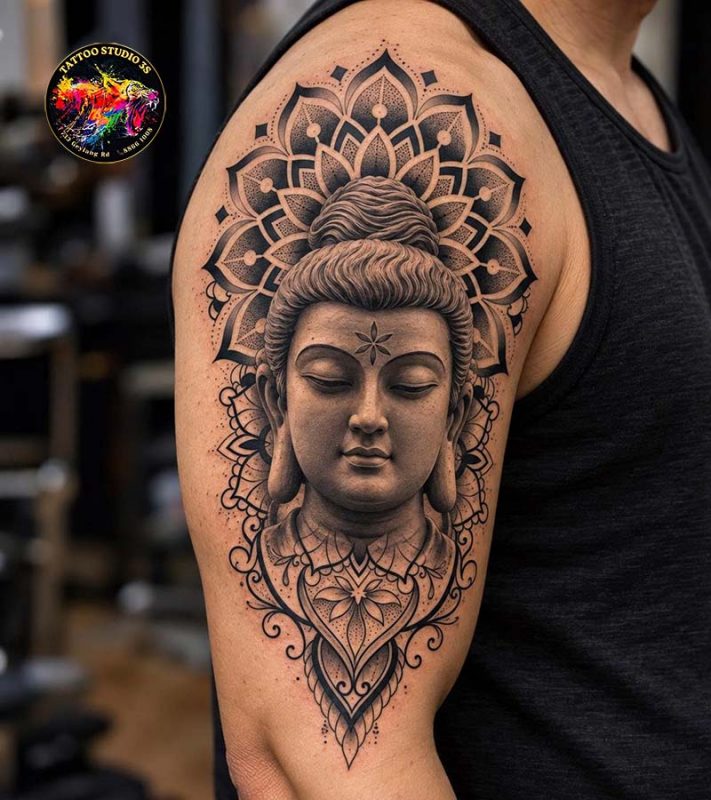
10. Buddha And Bodhi Tree Tattoo
The Bodhi tree has profound significance in Buddhism because Siddhartha Gautama is traditionally understood to have attained enlightenment while meditating beneath it. Combining Buddha with the Bodhi tree can therefore symbolize awakening, wisdom, spiritual development, and the search for deeper understanding.
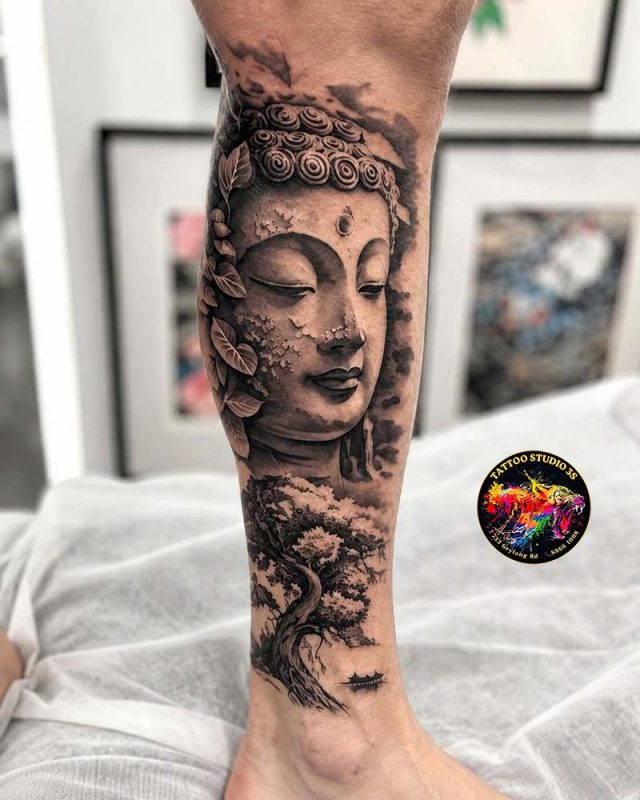
11. Buddha With Temple Tattoo
Temple architecture can create a rich background for a Realism Buddha Tattoo. Stairs, pillars, rooftops, statues, and architectural details can help establish a stronger cultural and spiritual atmosphere. This concept generally works best as a larger tattoo because the architectural elements require sufficient space.
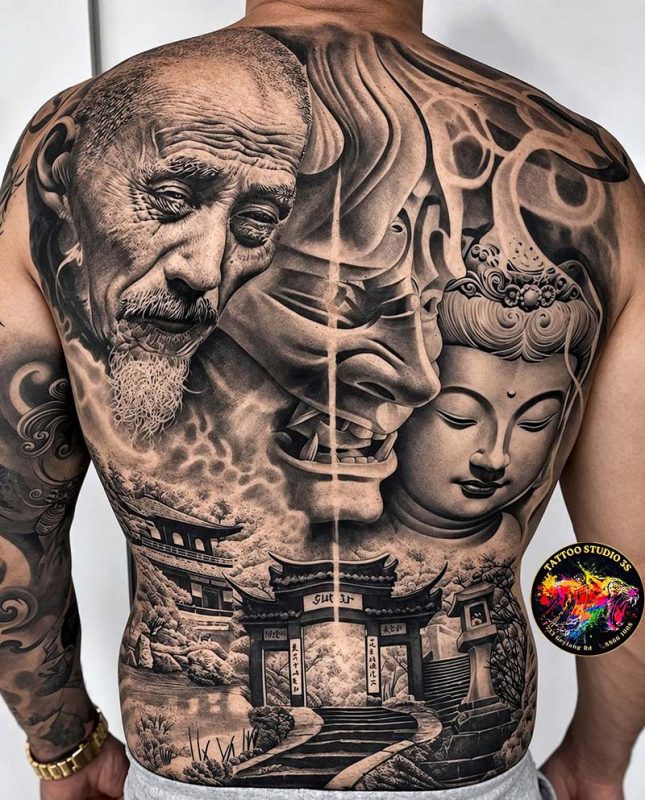
12. Buddha With Clouds Tattoo
Clouds can add movement and depth to a Buddha composition while keeping the overall appearance soft and atmospheric. They can also help connect separate elements within sleeves, back pieces, or leg tattoos.
13. Buddha With Third Eye Tattoo
A third-eye element is commonly used in contemporary spiritual tattoo art to represent intuition, awareness, and perception beyond ordinary sight. Because symbolism differs among Buddhist, Hindu, and modern spiritual traditions, it is useful to understand the origin of the specific imagery before combining it with Buddha.
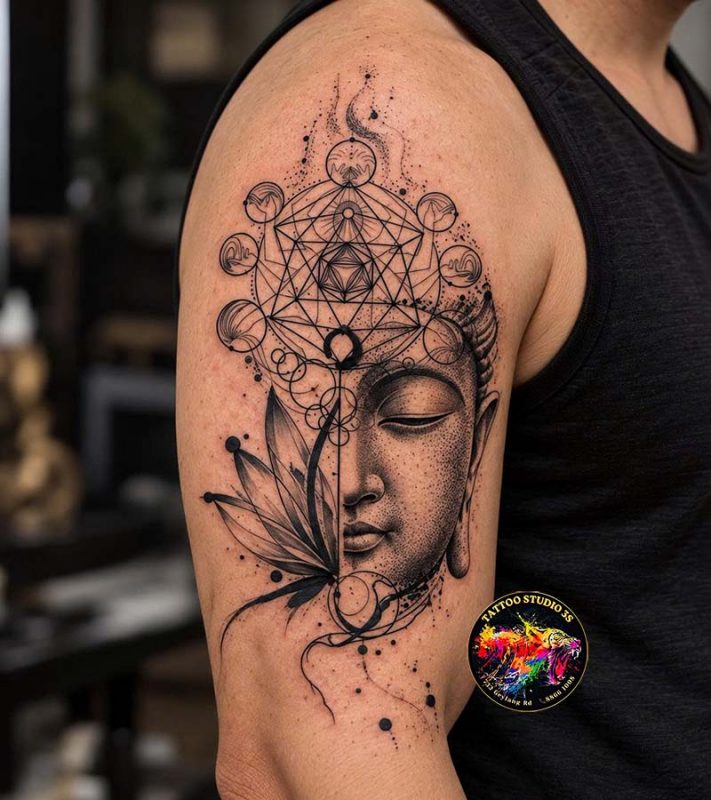
14. Buddha With Sacred Geometry Tattoo
Sacred geometric patterns introduce symmetry and structure into realism Buddha imagery. Circles, geometric grids, and carefully arranged patterns can frame the portrait and give a traditional subject a contemporary visual style.
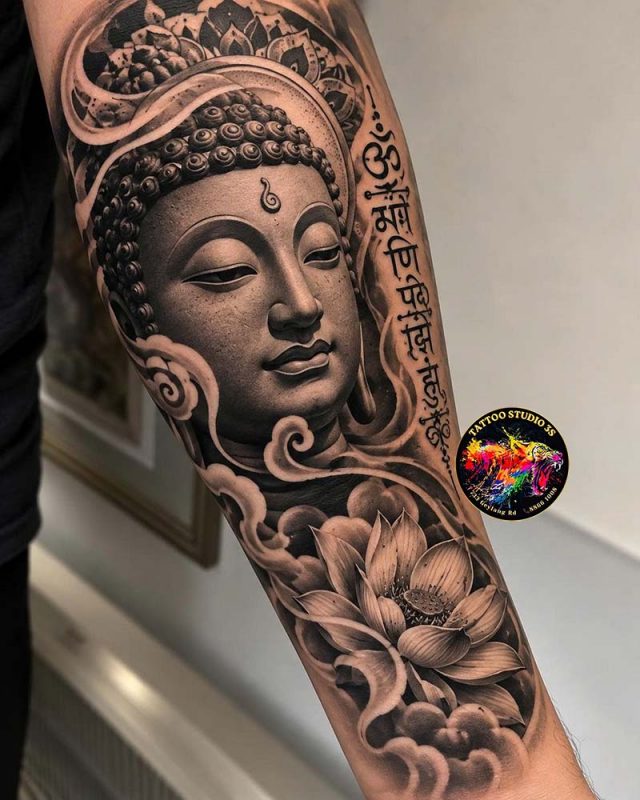
15. Buddha With Sanskrit Tattoo
Sanskrit words or mantras can be incorporated into a Buddha tattoo to add another layer of meaning. However, the text should always be verified carefully before tattooing. Incorrect spelling, grammar, or translation can permanently change the intended meaning, so it is best to confirm the wording with a reliable language or cultural source.
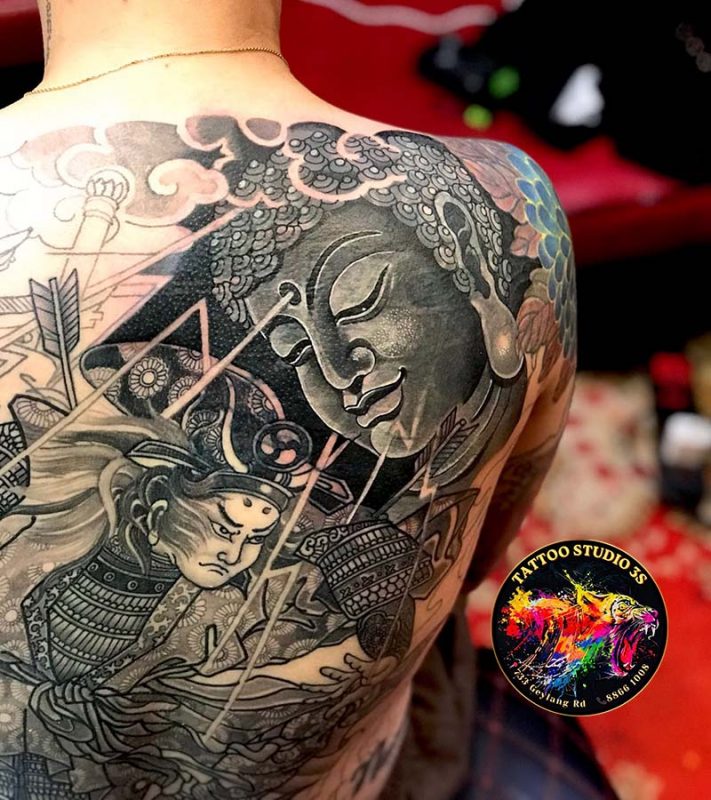
16. Black And Grey Realism Buddha Tattoo
Black and grey is particularly effective for realistic Buddha imagery. Smooth grey gradients, deep shadows, and carefully preserved highlights can produce strong depth without distracting from the peaceful expression. It is also an excellent option for designs inspired by stone Buddha statues.
17. Color Realism Buddha Tattoo
Color realism can create a richer and more vibrant interpretation. Gold, red, blue, green, and floral tones may be incorporated into clothing, lotus flowers, backgrounds, or surrounding decorative elements. The color palette should support the central Buddha image rather than overwhelm its facial details.
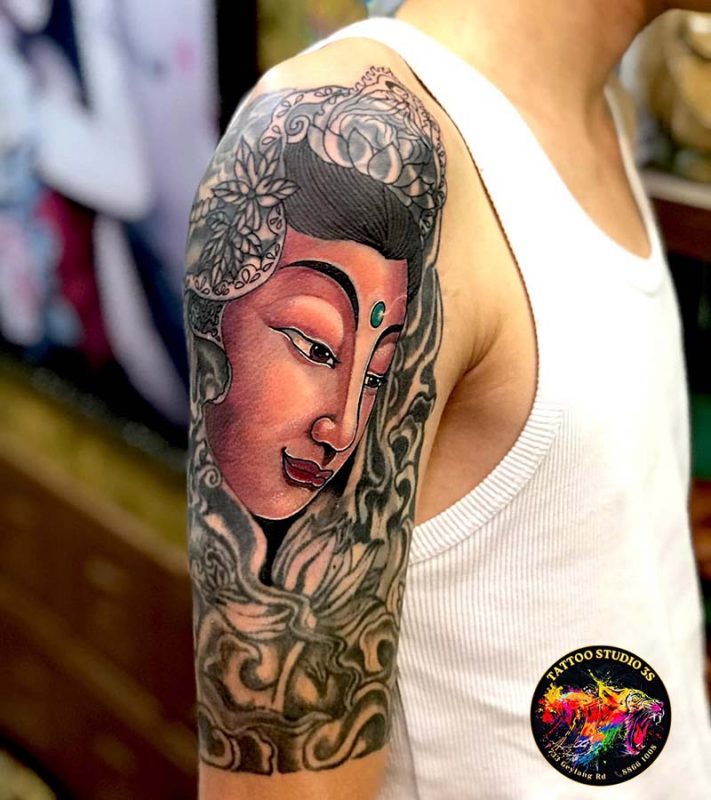
Black And Grey Vs Color Realism Buddha Tattoo
– Both black and grey and color can work beautifully for Realism Buddha Tattoo, but they create noticeably different visual effects.
– Black and grey emphasizes shadows, facial structure, texture, and depth. It is particularly effective when recreating Buddha statues because different shades of grey can closely resemble stone. The result often feels calm, timeless, and dramatic.
– Color realism allows artists to incorporate vibrant lotus flowers, temple details, clothing, backgrounds, or decorative elements. Color can make the composition more visually expressive while still maintaining realistic facial features.
– Neither option is universally better. The right choice depends on your preferred aesthetic, reference image, placement, skin tone, and the overall concept of the tattoo.
Best Placements For A Realism Buddha Tattoo
Realism requires sufficient space to preserve important details, so placement should be considered carefully.
- Arm: Suitable for medium-to-large Buddha portraits and compositions that may eventually become a sleeve.
- Forearm: Ideal for vertical designs and visible Buddha portraits.
- Shoulder: The rounded shape can complement Buddha faces and statue-inspired compositions.
- Chest: Provides space for wider, more dramatic designs.
- Back: One of the best locations for large, highly detailed Buddha artwork.
- Thigh: Offers a broad surface for portraits, statues, and complex backgrounds.
- Leg: Suitable for elongated compositions featuring Buddha, temples, lotus flowers, or natural scenery.
The amount of detail should always correspond to the available space. Increasing the tattoo size generally gives the artist more room to create smooth transitions and clearly defined features.
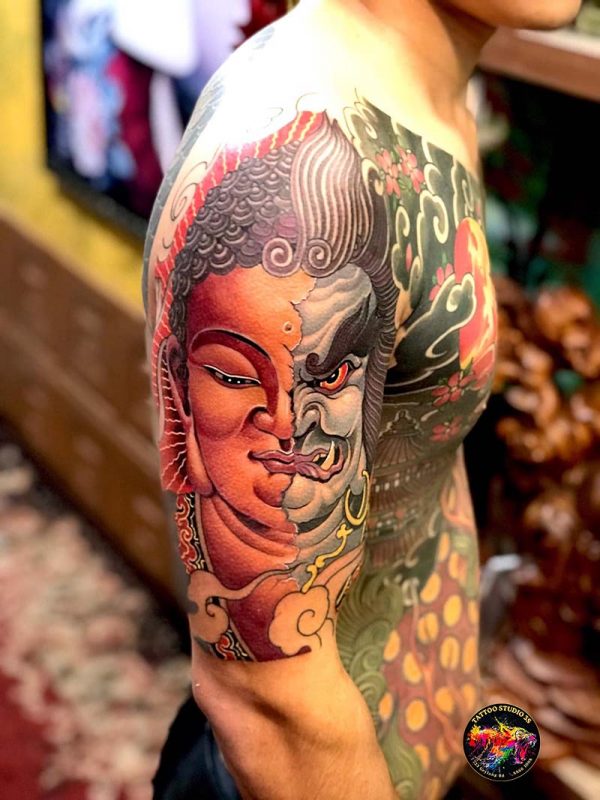
How To Choose The Right Realism Buddha Tattoo Design
A meaningful Buddha tattoo should be chosen with both artistic quality and cultural context in mind.
- Understand The Meaning Behind The Buddha Image: Research the figure, posture, hand gestures, and symbols before deciding on a design.
- Choose Meaningful Buddhist Symbols: Lotus flowers, Bodhi trees, mandalas, and other elements should complement the message you want the tattoo to convey.
- Consider Tattoo Size And Detail: Highly detailed portraits usually require more space than simple compositions.
- Match The Design With The Placement: The shape and movement of the tattoo should follow the natural contours of the body.
- Respect Buddhist Cultural And Religious Symbolism: Buddha is a sacred figure for millions of people. Avoid deliberately disrespectful imagery or placement, and consider cultural sensitivities surrounding Buddha tattoos.
- Work With An Experienced Realism Tattoo Artist: A skilled artist can adapt your reference into a design that maintains both visual clarity and appropriate proportions.
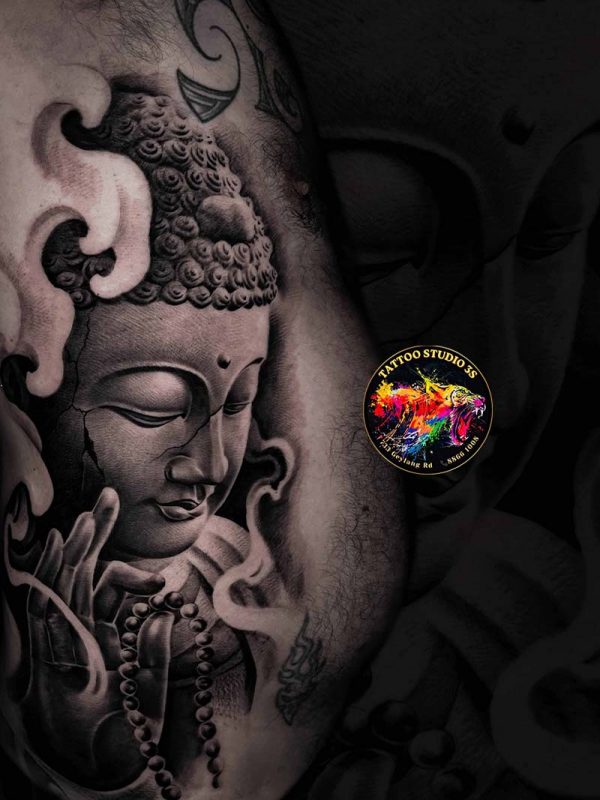
Why Realism Buddha Tattoo Require A Skilled Tattoo Artist?
– Realism Buddha Tattoo can be technically demanding because the expression of the face is often the most important part of the artwork. Small errors in the eyes, lips, nose, or facial proportions can significantly change the overall appearance.
– The artist must also understand how to create smooth gradients without making the tattoo muddy or excessively dark. Highlights, mid-tones, deep shadows, and negative space need to work together to create convincing three-dimensional depth.
– For statue-inspired designs, texture becomes another challenge. Stone, bronze, cracks, weathering, and carved details must look realistic while remaining readable after the tattoo heals.
– Most importantly, Buddha imagery often depends on a sense of serenity. Technical realism alone is not enough; the expression and composition should preserve the peaceful character intended by the design.
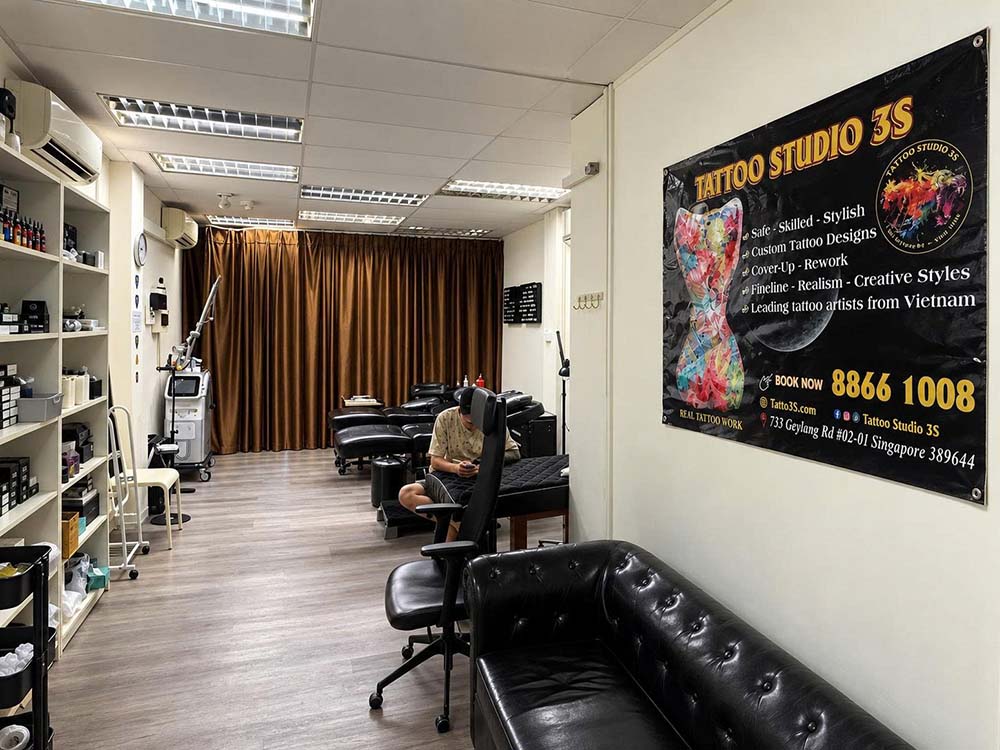
Tattoo Studio 3S – Realism Buddha Tattoo Studio In Singapore
For those looking for a Realism Buddha Tattoo in Singapore, Tattoo Studio 3S offers custom tattoo services with experience in realism, black and grey, portrait, and detailed tattoo work.
Each Buddha tattoo can be developed around your preferred imagery, symbolism, placement, and level of detail. Rather than simply copying a reference, the composition can be adapted to fit the natural proportions and contours of your body.
Reasons to choose Tattoo Studio 3S include:
- Experienced Realism Tattoo Artists: Detailed shading, facial proportions, texture, and depth are carefully considered throughout the design.
- Custom Buddha Tattoo Designs: Concepts can be personalized around Buddha imagery, lotus flowers, mandalas, temples, or other meaningful elements.
- Black And Grey And Realism Expertise: Techniques suitable for ealisticr portraits and statue-inspired artwork can create convincing depth and contrast.
- Personalized Design Consultation: References, size, style, composition, and important symbolic details can be discussed before tattooing.
- Tattoo Placement Consultation: The design can be adapted according to the available space and natural shape of the body.
- Professional And Hygienic Environment: Proper hygiene and professional tattooing practices are essential throughout the tattoo process.
Looking for a meaningful Buddha tattoo created with realistic detail? Discuss your concept with Tattoo Studio 3S and develop a custom design that reflects both your artistic preferences and intended symbolism.
- Hotline: +65 8866 1008
- Address: 733 Geylang Road, #02-01, Singapore 389644
FAQs About Realism Buddha Tattoo
What Does A Realism Buddha Tattoo Symbolize?
It can symbolize peace, wisdom, enlightenment, compassion, mindfulness, balance, or spiritual growth. The exact meaning depends on the Buddha image and accompanying symbols chosen for the design.
Is It Respectful To Get A Buddha Tattoo?
Attitudes toward Buddha tattoos vary across Buddhist cultures and communities. If you choose one, research the symbolism carefully, avoid intentionally disrespectful imagery, and consider cultural sensitivities around placement and presentation.
How Long Does A Realism Buddha Tattoo Take?
Tattooing time varies according to size, placement, complexity, and level of detail. Smaller designs may be completed in one session, while large sleeves or back pieces can require multiple sessions.
Do Realism Buddha Tattoos Age Well?
They can age well when the design uses appropriate contrast, spacing, and detail for its size. Proper healing, long-term skincare, and sun protection can also help maintain the tattoo’s appearance.